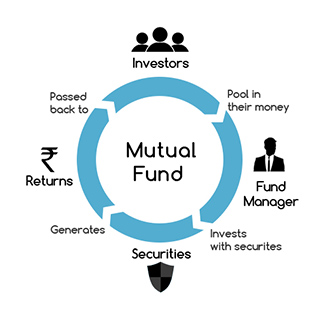
Mutual funds are basically investment vehicles that comprise the capital of different investors who share a mutual financial goal. A fund manager manages the pool of money that is collected from various investors and invests the money into a variety of investment options such as company stocks, bonds, and shares. Mutual funds in India are regulated by the Securities and Exchange Board of India (SEBI), and investing in mutual funds is considered to be the easiest way through which you can increase your wealth.
Mutual funds in India are classified into different categories based on certain characteristics such as asset class, structure, investment objectives, and risk. Here, we will help you understand in detail the various categories and the kinds of funds under each category.
Equity funds make investments mainly in stocks of companies. Equity funds are the most preferred investment options among the majority of investors as these offer high returns and quick growth.
Debt funds chiefly invest in low-risk fixed-income instruments such as government securities. Since these funds come with a fixed maturity date and interest rate these are ideal for investors with low risk appetite.
Money market funds invest in easily accessible cash and cash equivalent securities and offer returns as regular dividends. These funds come with relatively lower risk and are ideal for short term investment.
Balanced or hybrid funds invest a certain amount of their corpus into equity funds and the rest in debt funds. Though the risk involved with these funds is relatively high, the generated returns are equally high.
Open-ended mutual funds have no constraints as far as the number of units that can be traded or the time period is concerned. Investors are allowed to trade and exit from the funds at their own convenience.
The unit capital that is to be invested in closed-ended mutual funds is fixed and therefore, it is not possible to sell more than the predetermined number of units. The maturity tenure of the scheme is fixed.
Interval funds can be bought/exited only at specific intervals as determined by the company. These are open for investment for a certain period of time only. Usually, the investors need to stay invested for at least 2 years.
Investors can accumulate a significant amount of wealth through investment in a diversified portfolio that comprises high-performing schemes. However, there are so many different fund houses and schemes to choose from that it can be overwhelming to select the right portfolio. This is when a professional fund manager can come to your rescue and ensure that your money is invested in the funds that will offer maximum returns. Here are some of the key features of mutual funds:
Investments in mutual funds can be made by a variety of investors such as individuals, partnership firms, Qualified Foreign Investors (QFIs), registered Foreign Institutional Investors (FIIs), Persons of Indian Origin (PIOs), Non-Resident Indians (NRIs), cooperative societies, Hindu Undivided Families (HUFs), etc. To invest in mutual funds, applicants are required to be KYC compliant.
An increasing number of individuals in India have taken to investing in mutual funds, but a good percentage of the investors have no idea how to go about it. Here are some tips to help you kick-start your investment in mutual funds:
Before you put your money into an investment vehicle, it is important to identify your financial goals. You must know how much money you wish to invest in order to achieve your goals. In case you have short-term goals and require funds in say, two to three years, debt schemes would be the way to go. In case you have long-term goals and require funds after say, five years or so, equity schemes can help you achieve your goals. Once you identify your goals, choosing the right funds becomes much easier.
As you already know, there is a wide variety of mutual fund schemes within the equity and debt fund universe. In order to choose the right scheme, you will have to take into consideration your risk appetite, your investment horizon, and your financial goals. Compare different schemes to find the ones that are in line with your risk profile and your investment horizon.
If you are investing in mutual funds directly by yourself, a fund advisor can be of great aid in helping you achieve your financial goals. Experienced advisors not only help in taking care of the formalities, but they also suggest schemes that can help you generate returns. Many advisors also tend to keep track of your investments, thereby enabling you to switch in case one of your investments is underperforming.
All transactions made in the mutual funds domain must be well documented. It is necessary to be KYC compliant when transacting with mutual funds, which is just a due diligence of certain personal information such as furnishing your photograph, address proof, PAN, and DOB certificate. Ensure that you have a PAN card as it is one of the requirements for investing in mutual funds.
Considering the wide variety of mutual funds on offer, make sure you pick only those that cater to your risk appetite. The higher the returns offered by a scheme, the higher the risk associated with it, therefore, making it important to ensure that you choose your funds wisely.
Most mutual fund schemes come with options such as growth and dividend. When choosing a scheme and the options under it, it is essential to consider your financial objectives to get the most out of your investment. Growth options are ideal for those who want a large amount of money to meet their financial objectives. Dividend options, on the other hand, are ideal for those who require profits at regular intervals of time.
The time-frame for achieving your investment objective must be finalised before you invest in mutual funds. As you grow older and approach retirement age, your exposure to stocks must be limited as it will ensure that your capital is preserved. A professional fund manager can help you better understand where to invest your money.
| Regular Plan | Direct Plan | |
|---|---|---|
|
IDFC Focused |
Expense - 2.4% Value Research Rating |
Expense - 0.46% Value Research Rating |
|
Axis Long Term |
Expense - 2.51% Value Research Rating |
Expense - 1.26% Value Research Rating |
|
Aditya Birla Sun |
Expense - 2.23% Value Research Rating |
Expense - 0.98% Value Research Rating |